
At-Home Workout For Women Over 40 (Beginner-Friendly Plan)
About the Author
Written by Girija | Girija Fitness World
Girija is the founder of Girija Fitness World, a women-focused fitness and wellness platform. I create simple, practical content about fitness after 40, healthy weight management, nutrition, strength training, meditation, and women’s wellness.
You don’t need a gym membership to begin exercising after 40.
Perhaps you just have a busy day, family commitments, or no desire to go to a gym. That’s fine. A home workout for women over 40 can be easy, effective and take far less time to do.
It’s not about working out for hours. The challenge is to discover a routine that you can really stick to and enjoy.
Why go for a home workout after 40?
One of the main benefits of an at home workout is that it is convenient. You don’t have to travel to a gym or wait for equipment. You just need to put on your workout gear and make a little space and begin.
Start with your own body weight and incorporate resistance bands or light dumbbells when you’re ready.
A strong beginner workout is also a perfect way to target strength, flexibility, balance, and functional movement, all while working at a rate that’s right for you.
And don’t forget, you don’t have to exercise until you’re completely drained each time you work out.
Consistency matters.
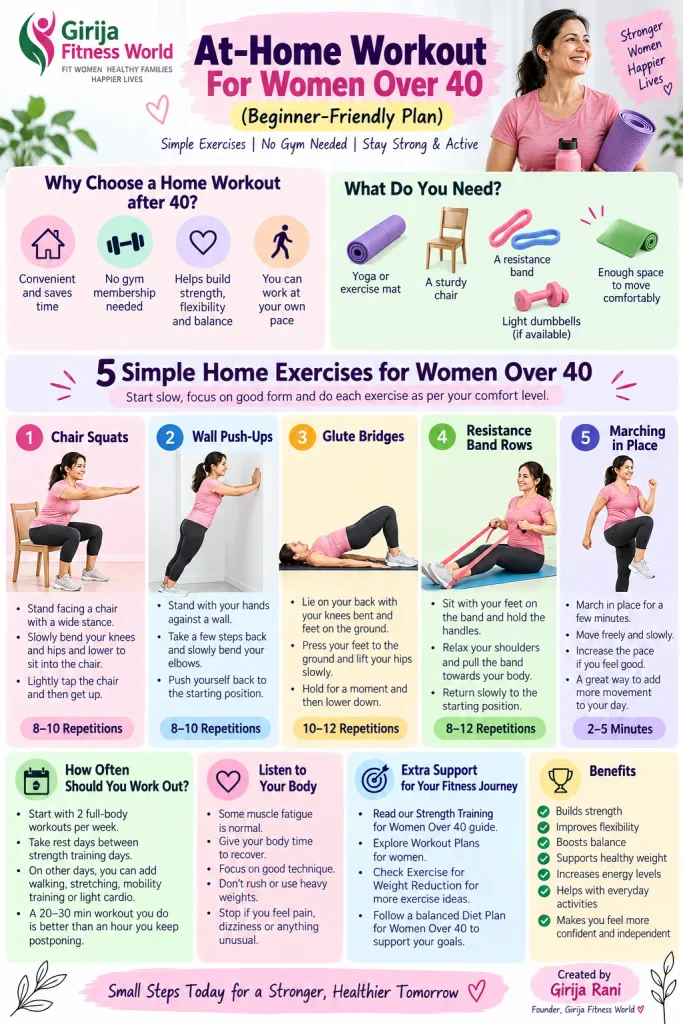
What are the requirements for a home workout for beginners?
You don’t need a ton of exercise equipment.
One simple home workout for women over 40 to start with:
- A yoga or exercise mat
- A sturdy chair
- A resistance band
- Light dumbbells, if available
- Enough space to move comfortably
No dumbbells yet? No worries. Begin with bodyweight workouts and understand the pattern first.
Beginner-Friendly Home Workout Plan
Begin with 2 days a week if you’re new to working out or doing it after a long gap. Take rest days between these two strength training days to give your body time to recover.
Here’s a straightforward full-body workout to begin with.
1. Chair Squats
If regular squats are challenging, chair squats are a suitable alternative.
Stand facing a chair that is in front of you with a wide stance. Gradually bend the knees and hips while lowering to sit into the chair.
Lightly tap on the chair and then get up.
Try 8-10 controlled repetitions.
2. Wall Push-Ups
These wall push-ups are less challenging than doing them on the floor so you can build your upper-body strength over time.
Stand with your hands against a wall and your palms against the wall. Take a few steps back and gradually bend your elbows.
Push yourself back to the starting position.
Begin with 8-10 reps, maintaining control.
3. Glute Bridges
In a supine position with your knees bent and your feet on the ground.
Firmly press your feet to the ground and lift your hips slowly. Slightly hold yourself in the air and lower yourself to the ground again.
Try 10-12 repetitions.
Don’t try to get as much height as possible off your hips, concentrate on the control of the movement and activating the glutes.
4. Resistance Band Rows
RESISTANCE BAND (OPTIONAL) Use the resistance band if you want to add rows for your upper back and arms.
“Relax your shoulders, and then pull the band down towards your body. Return slowly back to the starting position.”
Try 8-12 repetitions without swinging your body.
5. Marching in Place
End your session with a few minutes of relaxed marching in place.
Move freely and softly, accelerate as fast as you want if you feel fine.
This is also a quick tip to squeeze some extra movement into your day without any extra equipment.
How Many Times a Week Should a Woman Over 40 Exercise at Home?
Working out every day is not the only way to get value out of a workout.
Beginner: Stick to 2 full-body training days each week. You can add walking, stretching, mobility training, and light cardio on your off days.
As you improve, you can start extending your session time, increasing repetitions, adding resistance or doing more sessions.
Don’t try to do everything at once.
A 20-30 min workout you do is much more valuable than an hour long workout you can’t stop putting off.
If you want to explore a more structured routine, you can also see the Workout Plans for Women Over 40 available through Girija Fitness World.
Listen to Your Body
This is very crucial when you’re merely beginning a new routine.
Expect to feel a little muscle fatigue in the days after a workout, especially if your body is not accustomed to a regular exercise program. Allow time to recover.
Give priority to good technique instead of trying to do multiple reps too quickly or using an increased weight.
Stop exercising immediately if you experience any pain, dizziness, or anything that does not feel quite right.
For women who are also working on weight management, you can combine regular movement with Exercise for Weight Reduction as part of a broader fitness routine.
Disclaimer
The information provided in this article is for general educational and informational purposes only. It is not intended to replace professional medical advice, diagnosis, or treatment.
Final Thoughts
Keen to give a more understated workout a go for women over 40?
You don’t need perfect tools, a crazy workout plan, and hours of free time. Use basic exercises, concentrate on your technique, and be patient with yourself.
Everyone has days when they feel a little stronger and more focused than other days. That’s all right.
It’s not a competition about who’s doing better at someone else’s program. It’s about creating a program that works for your body, your life, and your schedule.
Begin with baby steps, and create consistency as you go, so your strength builds one day at a time.
Frequently Asked Questions
Which exercises are best for seniors?
You could try a simple full-body workout, like chair squats, wall push-ups, glute bridges, resistance band rows and some mild cardio.
Can a woman over 40 work out at home without equipment?
Yes. Start with your own bodyweight. Later on, if you want a bit more, you can start adding some resistance bands or lightweights.
How often should women over 40 work out in a week?
As a beginner, two full-body workouts per week might be an easy starting point. Throw in some walks, stretching, or other light activity on the remaining days.
How long should a beginner home workout take?
You could start with something like 20-30 mins. It’s about finding something that isn’t overwhelming in your schedule and that you can still stick to.