
Perimenopause Workout for Women: Beginner’s Guide
Written by Girija Rani
Fitness Advisor & Founder, Girija Fitness World
Published: 8 -october- 2026
Last Updated: 8 -october- 2026
Throughout perimenopause, you might realise that exercising has become quite different to when you first started in your twenties or thirties. You might notice things like shifts in energy levels, sleep, body shape, recovery, mental health or strength in your body. That doesn’t mean you should stop exercising, but perhaps a good time for a change in the way you exercise.
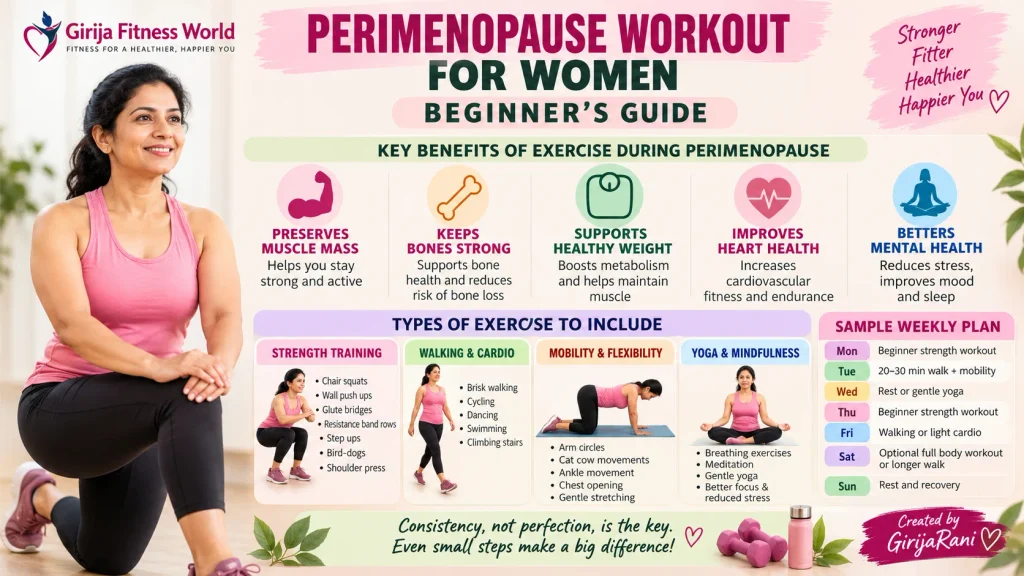
A perimenopause workout for women that will do your body good… Build strength, maintain mobility, support bone health, increase your cardiovascular fitness, and keep you moving without overfatiguing.
Fortunately, you don’t have to have a fancy workout plan. A total of body workout can incorporate walking, body weight workouts, resistance bands, little dumbbells, mobility workouts and yoga.
What is perimenopause?
Perimenopause When your periods and hormone levels start to shift unpredictably; this can begin a few years before menopause. Your experience will be unique to you.
You might find you’re experiencing things such as sleep disturbance, hot flushes, mood swings, fatigue or that your body composition is shifting. This may require a bit more flexibility with your training and a stronger focus on recovering.
While exercise may not alleviate all menopausal symptoms, it’s great for your overall health. Loaded up muscles and bones can be maintained with weight bearing exercise and strength training.
An efficient workout for menopause, women over 40, can keep you moving and also help a range of health problems.
Why Menopause Calls for Exercise
1. Aid Preserving Muscle Mass Strength
As we age, muscle mass is so important to us, and quite naturally You can build and keep muscle with strength training using your body weight, resistance bands and/or free weights.
If you don’t work with heavy weights to start with, when you begin, do the exercise at a weight you are able to manage with good posture.
For more information, you can also read our strength training for women over 40 guide.
2. Keeps Bone Strong
Bony health is a concern at all stages of menopause. Resistance and weight bearing exercise will help to strengthen your bones.
You can get some or all of these activities into a balanced exercise program:
Walking
Climbing stairs
Dancing
Working out with a resistance band
Strength training.
3. Promotes Healthy Weight Management
Hormonal shifts during middle age can be a source of frustration. In addition to maintaining an active lifestyle to keep metabolism high, add strength training to support muscle retention.
However, that’s not to say that exercise should be a punishment for eating. The sustainable way to exercise is to adopt a balanced, regular routine that incorporates activity, strength training, optimal nutrition, sleep and rest.
You can also explore our safe weight loss exercises for women over 40 for related exercises.
4. Aids Cardiovascular health
Heart rate raising exercises including walking, cycling, dancing and swimming can help improve cardiovascular endurance.
The current guidelines for physical activity for adults are that they should accumulate at least 150 minutes of moderate-intensity aerobic activity per week and participate in muscle-strengthening activities at least two days a week.
There’s no need to hit this target as you go. If you’re having difficulty, take shorter periods of activity initially and build gradually.
The Best Exercise During Perimenopause
Alternate among varying forms of exercise; don’t train Cardio and/or Strength exclusively.
Strength Training
Include a strength training aspect to your program.
Easy workouts for the starters are:
- Chair squats
- Squats (bodyweight)
- Bridges for the buttocks
- Wall push ups
- Resistance band rows
- Dumbell rows (light)
- Step ups
- Shoulder Press
- Bird-dogs,
- Farmers carries
Begin with the smaller movements and keep your focus on precision exercise technique not the amount of weight you are lifting.
Other Cardio and Walks.
Walking is a great simple way to get some daily movement in.
Begin with 10-20 minutes and build up gradually. Brisk walk that gets your breathing and heart rate up but that you can still talk during can be moderate intensity physical activity.
B. Sit on the floor comfortably and do some gentle stretching exercises to improve your mobility & flexibility. If you prefer swimming, playing football, cycling, or dancing, these can also be recorded.
Cardiovascular (Aerobic) Capacity & Endurance
Mobility work can be a game changer if you spend long periods of time sitting or just feel tight in the morning.
Try soft:
- Arms in circle
- Circles
- Cat cow movements
- Ankle movement
- Stretching the chest opening
- Easy hamstring stretches
You don’t have to do a long stretch. Short sessions of 5-10 minutes can be a helpful part of your day.
Body Awareness and Yoga
Combine yoga, breathing exercises and meditation to give your program more strength.
These can be especially useful on days when you feel like being active but don’t have the motivation for a tough workout. The 2026 clinical practice recommendations of the Indian Menopause Society recommend aerobic, strengthening muscle, breathing, balancing, and mind-body exercises as part of exercising in the menopausal transition.
You can also explore mindfulness and meditation as part of your overall wellness routine.
Perimenopause Home Exercise for beginners.
Here’s an easy at home workout.
Warm Up – 5 Minutes
Begin gently with:
- Marching in place – 60 seconds
- Shoulder rolls – 30 seconds.
- Arm circles – 30 secs
- Hip circles – 30 seconds
- Chair sit to stand – 1 min.
- Lightly stroll about the room – 1 minute
The workout itself
Slow down and do the exercise one at a time, and focus on it.
1. Chair Squats – 8-12 reps
In front of a strong chair, Stand in front of a chair, big knees, sit back. Control! Squat back and then don’t plop: Stand up.
2. Wall Push-Ups – 8 to 12 repetitions
Wall push-ups Position yourself standing with hands against the wall and keeping your body straight. Bend your elbows and lean towards the wall and then away from the wall.
3. Glute Bridge – 10-15 rep
Lie down and bend your knees. In a smooth controlled movement, squeeze your glutes to lift your hips and lower down again.
4. Resistance band rows – 8-12 reps
Keep your shoulders down and pull the band toward your body, focusing on squeezing through your upper back.
5. Step-Ups – 6 to 10 reps on each leg
Choose a low step that is steady. Step up and down slowly. Don’t rush. If needed, hold on.
6. Bird Dog – 6 to 10 reps each side
Position yourself on your hands and knees then extend one arm and opposite leg away from your body. Keep your core stabilized and move slowly.
Beginner: 1-2 rounds Once you become more fit you can add more rounds or more resistance.
The number of days a week should women work out in the perimenopause stage?
You don’t need to push yourself every time you exercise.
Here’s a very basic weekly schedule:
| Day | Activity |
|---|---|
| Monday | Beginner strength workout |
| Tuesday | 20-30 minute walk + mobility |
| Wednesday | Rest or gentle yoga |
| Thursday | Beginner strength workout |
| Friday | Walking or light cardio |
| Saturday | Optional full body workout or longer walk |
| Sunday | Rest and recovery |
The goal here is consistency, not perfection.
Even if you’ve just begun to exercise any even small amount is a step forward. It is preferable to gradually approach the suggested amounts of exercise than to begin a relentless program of exercise and give up when feeling tired.
You can also explore our workout plan for women over 40 for a structured workout routine.
Is HIIT unsafe in perimenopause?
You don’t have to do HIIT to stay fit during perimenopause.
Some women prefer higher intensity workouts, while others just enjoy a walk, weight training, cycling, swimming or a lower impact workout.
If you are new to working out, begin with at a level of moderate intensity. After you establish a physical body for yourself, you may choose to increase your level of intensity to obtain more out of your exercise routine.
Frequently Asked Questions
What is the best way to workout during perimenopause?
A mix of strength training, walking, cardio, yoga, mobility work, and any other sort of workout you enjoy is a good perimenopause workout.
What is the best way to workout during perimenopause?
Try to incorporate some kind of activity each day for the week, focusing on strength training at least twice a week and walk for exercise or some other type of cardio on other days.
workout during perimenopause?
Try to incorporate some kind of activity each day for the week, focusing on strength training at least twice a week and walk for exercise or some other type of cardio on other days
Can I do strength training during perimenopause?
Yes. According to the Mayo Clinic, strength training can promote strong muscles and healthy bones. Those who are new to strength training should use a light resistance and emphasize good form.
Is HIIT safe for perimenopause?
Perimenopause doesn’t mean you have to do HIIT to stay in shape. You can workout at moderate intensity for now, and then add more as your fitness levels improve!
About the Author
Girija Rani is the Fitness Advisor & Founder of Girija Fitness World. I shares practical fitness and healthy lifestyle information based on personal experience, ongoing learning and research from reliable sources
Disclaimer: This article is for general educational purposes and is not a substitute for personalized medical advice. Individual results may vary. Read our Fitness & Health Disclaimer for more information.
Frequent searches leading to this page:- Fitness After 40,Healthy Lifestyle,Girija Fitness World,Women Over 40 Fitness,Home Exercises for Women,Obesity Recovery,Healthy Lifestyle Changes,Recovery Journey,
Exercise for Women,Women’s Health