Women Over 40 Strength Training: A Beginner’s Guide
However, getting back into the gym after 40 can feel a little different. You probably don’t have as much time on your hands as you did in your 20’s, and your body might need a touch more time to recover. That’s totally normal.
But that doesn’t mean you can’t continue to get stronger as you age.
Strength Training for Women Over 40
Strength training for women over 40 doesn’t have to be complicated. You don’t need fancy gym equipment and a costly membership to get started. You can start right in your own home with just your own bodyweight or a resistance band or a pair of light dumbbells.
What matters is you start at a level you’re comfortable with and gradually work up to it.
The older we get, the more we need to stay strong. Regular strength exercises can improve muscle strength, bone strength, balance, mobility, and the movements we take for granted every day.
If you’re also working on healthy weight management, you can combine strength training with a balanced nutrition routine. You can learn more about diet plans for women over 40 as part of your overall fitness routine.
Why Is Strength Training Necessary for Women Over 40?
Some people associate strength training with lifting really heavy weights at a gym. But that’s not what you should be thinking about as a beginner.
Strength training is more about being stronger, and feeling more competent in daily living, for women over 40.
Think about simple things such as:
- Carrying grocery bags without struggling
- Walking up a flight of stairs
- Getting up from a chair easily
- Picking something up from the floor
- Be active without feeling tight or weak
These are all activities that stronger muscles could also make life easier.
Engaging in resistance exercises on a regular basis could also potentially contribute to maintaining lean muscle tissue, strong bones, good balance and mobility and a sense of physical independence.
And no, you don’t have to give up your walks or cardio and pick up the weights instead. You can combine both into a weekly workout plan.
If weight reduction is also one of your goals, you can explore these safe weight loss exercises and combine them with your strength-training routine.
How to Strength Train After 40 for the First Time?
If you’ve not been active for a long period of time, don’t think you’ve got to play catch up.
Start slowly.
In the early stages, it’s not about lifting heavy weight but about getting the feeling of a movement. Good exercise form is always far more important than using high weights.
You can begin with:
- Bodyweight exercises
- Resistance bands
- Light dumbbells
- Easy workout routines you can do at home
Beginner Tips For Starting Out
When beginning, two strength training workouts per week is a manageable goal. Don’t have them on consecutive days so your muscles can recover.
As the exercises become less challenging, add repetitions or resistance.
If you are looking for a structured routine rather than choosing exercises individually, you can also explore these workout plans for women over 40.
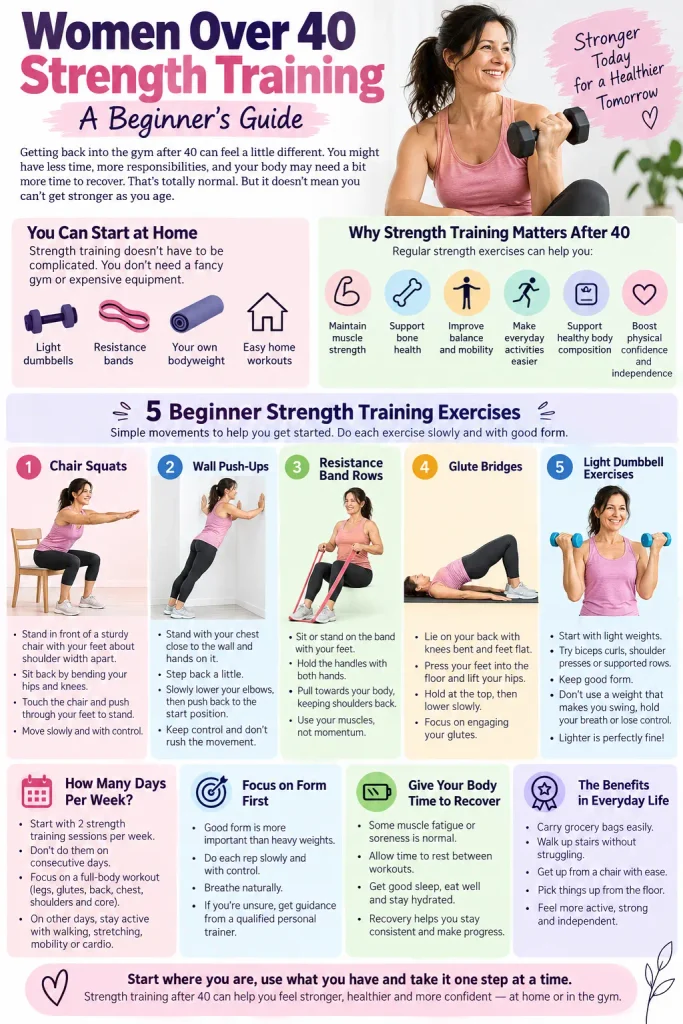
5 Beginner Strength Training Exercises for Women Over 40
You don’t need an intense workout to begin with. A handful of simple movements can hit many of the larger muscle groups.
1. Chair Squats
One of the easiest progressions is chair squats if you find regular squats challenging.
Stand in front of a sturdy chair with your feet about shoulder width apart. Sit backwards by bending your hips and knees.
Touch the chair and push again through your feet to stand.
No need to do a ton of reps. Concentrate on moving at a slow and controlled speed.
2. Wall Push-Ups
Floor push-ups might be too hard when you’re just beginning. Wall push-ups offer an easier variation.
Stand with your chest close to the wall and your hands touching it. Step your dominant foot back a little. Slowly lower your elbows, moving your body toward the wall, and then straighten your arms to return to the start position.
Maintain control of your body rather than flying through the repetitions.
The more strength you gain in your upper body, the more the following push-up variations can be leaned into.
3. Resistance Band Rows
Upper Back and Arm: Resistance Band Row
Resistance band rows are an easy upper-back and arm workout.
Leaning on the band Place the band on your feet and hold the handles/ ends with your hands. Relax your shoulders and move your hands slowly towards your body.
Consider retracting your shoulders instead of just pulling with your arms.
Don’t slam your whole body. This force should not be generated by momentum, but by muscles.
4. Glute Bridges
Beginner Friendly Workout With Glute Bridges
Another totally newbie friendly one to do at home.
Flat onto your back, knees bent and feet on the ground.
Press your feet down into the floor and gradually lift your hips. Hold at the top, then lower down slowly.
Make sure you can feel your glutes activate. Remember, a full lift of the hips is not necessary. Speed is not an issue at all, control is key.
5. Light Dumbbell Exercises
When you’re confident enough with your own body, start using lighter dumbbells to work out.
Based on your level of fitness you can also incorporate in exercises like, biceps curls, shoulder presses and supported rows.
And remember, heavier doesn’t automatically mean better.
Select a weight that enables you to keep proper form. You should not be using a weight that causes you to swing the dumbbell, hold your breath, or alter your body position to complete a repetition.
There’s nothing wrong with going lighter.
Strength Training: How Many Days a Week for Women Over 40?
If you’re just starting out, two days a week is a safe number of days to train.
You can train the entire body at each workout rather than attempting to train each body part and muscle separately.
A beginner full-body workout may consist of exercises to:
- Legs
- Glutes
- Back
- Chest
- Shoulders
- Core
The rest of the week, stay active doing whatever you love. Walking, stretching, mobility work, or a bit of cardio can all serve you well with your strength workouts.
The most effective workout program is rarely the one that looks best on paper. It’s the one you can adhere to day in and day out.
Focus on Form Before Increasing Weight
And if there’s one piece of advice I’d offer a newbie who, like me, wanted to start lifting weights in middle age, it’d be: hold off on increasing the weight you’re lifting.
Learn the movement first.
Proper technique allows you to maintain control of the movement and accurately monitor what your body is doing. Take your time on each repetition.
And don’t forget to breathe.
If you’re not 100% sure you’re doing an exercise the right way, it might be worth talking to a qualified personal trainer who can demonstrate the movement and tell you what modifications you could make depending on your level of fitness.
Give Your Body Time to Recover
Recovery is also part of strength training.
After beginning a new work out regimen, you may observe a little bit of muscle fatigue or aches. This doesn’t imply that you should push your self more the next time you work out.
Give your body time to recover.
Getting good rest, having a healthy diet, drinking plenty of water, and slowly ramping up your workout will help you stay consistent.
If nutrition is part of your overall fitness goal, you can also explore a personalized diet plan for women over 40.
Final Thoughts
No need with what you can do easily, master the technique and slowly increase the difficulty of your work outs as you get stronger.
About the Author
Written by Girija | Girija Fitness World
Girija is the founder of Girija Fitness World, a women-focused fitness and wellness platform. I create simple, practical content about fitness after 40, healthy weight management, nutrition, strength training, meditation, and women’s wellness.
Disclaimer
The information provided in this article is for general educational and informational purposes only. It is not intended to replace professional medical advice, diagnosis, or treatment.
Every woman’s body, health history, lifestyle, and nutritional needs are different.
Frequently Asked Questions
Can women over 40 start strength training as beginners?
Yes. New beginers can begin with bodyweight exercises, resistance bands or lightweight dumbbells and continue to progress.
For women over 40, how many days a week should they do strength training?
For beginners, two days of strength training can be a manageable starting point, with at least 24 hours between strength training sessions.
Should you be using heavy weights over 40?
No. Start with your bodyweight, resistance bands or some light dumbbells. Slow down and master good technique before advancing to heavier weights.
Is it possible to do strength training at home over 40 years?
Yes. Most beginner exercises, such as chair squats, wall push-ups, resistance band rows, and glute bridges, require little or no equipment and can be done at home.